
Growing up, my family always had a Christmas tree. We bought a new one every year, preferring the traditional evergreen fir-tree to any plastic analogue. When I got to be about 5 years old, I began to ask why we required a freshly cut tree every year when it served no practical purpose and was simply thrown to the curb a month later. When my parents split up, both of them began to buy Christmas trees for the holiday seasons, which was a decision I truly couldn’t wrap my head around. The answer to the question why, as anyone who has asked a similar question knows, is tradition.
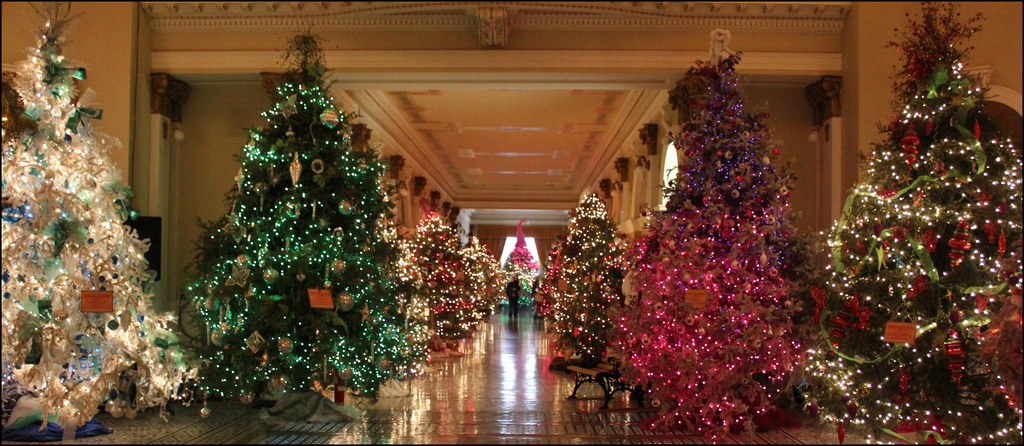
As I got older, I began to ask myself whether tradition was actually a reasonable argument for doing anything. I also began to ask myself how the world of tradition fit into the world of science and technology in which we live. Ironically, tradition stems from a sort of science: the empirical (in the actual definition of empiricism: so based on experience) science of seeing someone do something a certain way and having nothing go wrong (or even go well).
The most dangerous phrase in the language is, “We’ve always done it this way.” – Grace Hopper.
Oftentimes our traditions carry great symbolic value and have been maintained for just this reason, even if the average person is unaware of them. The Christmas tree is a sign of fertility during the coldest and longest nights of the year, staying green while everything else around it dies or shrivels up for the winter. The ornaments and lights are derived from the nuts and apples that people used to hang on the trees; pretending that their evergreen tree was bearing fruit at a time of year where only warm-blooded animals even think of reproduction.
But, how much sense does it make for us to continue this reminder of life into an age where we can drink orange juice and eat bananas during the winter solstice? If we had to do it, does it make any sense whatsoever to cut down, and then throw out, a new tree every single year? Could it be that what was once a helpful reminder of life and hope has become, ironically, a reminder for our unconscious and often reckless way of life?
Almost everyone is aware that more than half of the world’s forests have been cut down in the last 70 years, and that we are allowing companies to replace these forests with monoculture “tree farms” to which we attribute equivalent value. Currently, the EPA defines “forest lands” as “a forested area as “forest land” if it is at least 1 acre in size and at least 10 percent occupied by forest trees of any size or formerly having had such tree cover and not currently developed for non-forest use.”
This means that if a company buys a piece of natural forest, cuts down all the 10+ meter trees and undergrowth of different types, and replaces it with a smaller monoculture, it will not be registered statistically in regard to “forest lands”. We are continuing to kill off natural forests, replacing them with industrial imitations, and telling ourselves that everything is fine. This too is powered by the traditional thinking that a group of trees is equal to a group of trees and that an ecosystem will always recover: myths that science has thoroughly dispelled.
Tradition is a powerful thing, it has often been used to embroil hatred towards the new or to give new radical positions a familiar feel. Tradition has been used to sanction violence against children and minority groups, to trade slaves, and to sacrifice the lives of both animals and people. It has been used to ignore technological advances, protect unethical business models, and defend philosophical positions long divorced from rational thought.
Tradition has been used to justify all this, and more, based simply on the argument that “it has been done like this before, so it must be the right way.” This is a similar line of argument as saying that something must be right because so many people do it or approve of it, also known as “argumentum ad populum.” A few hundred years ago, this very style of argument was used to defend the trading of slaves. If history has taught us just one thing, it is that what people believe is not necessarily the same as what is right.
During the last several hundred years, some would even argue thousand, we have collectively become comfortable with thoughtless and occasionally pointless ecological destruction. We now consider ourselves as traditional exploiters and owners of the environment, some kind of global ecological parasite, with some arguing that only the hellfire predicted in the Bible can set things right. Ironically, we have been caught in the tradition of accepting irrational or harmful behavior simply because of its “traditional” place in our society.
Tradition is not always wrong, but it is most certainly not always right. It survived as a way of doing things because we did not take the time to assemble, compile, and analyze data prior to the scientific revolution. Before that point, many were satisfied with knowing that what they were doing would not directly blow up in their faces, and little time was spent discussing the theoretical meaning or value of the various traditions. As creatures of habit, humans have been largely happy to continue with whatever traditions have managed to establish themselves.
We now have the ability to examine the meaning and costs of our traditions. We can ask ourselves “why” and even “if this continues to make sense.” Many have traditionally barbecued to celebrate during the summer, but does this make sense in the face of research regarding the health impacts of both charcoal grilling, the temperatures reached during such a process, or the unnecessary carbon emissions caused by a long-lasting open fire? The same line of questioning begs us to wonder if we really need a Christmas tree at all to be reminded of life and growth, or if this is an ecologically unsound tradition we would be smarter to do without?
The fir-trees we use for Christmas don’t originate from some forest most of the time these days: they are grown in tree farms like those described above. This tree farm may be found on land that was a forest, or which was previously producing food. The repeated growth and exportation of the trees grown on this land, of course, leads to depletion of minerals in the soil and reduces biodiversity in the affected area. This is the price that we pay for tree farms or the establishment of any type of monoculture. The operation of these kind of trees farms is, as mentioned above, perceived on paper as being equivalent to an actual forest.
Certainly, no individual act will stop the staggering loss of wildlife. Multiple meta-analyses have confirmed that we have seen animal populations shrink by 52% in the last 40 years. To counter this trend, we will need to do a lot more than not buy another Christmas tree or request that our cities stop buying them to display publicly. But if the first step to a more responsible lifestyle has to start somewhere then why not with highly visible and common traditions? After all, a brighter future is not just the result of finding better answers to new problems but also to sorting through and correcting answers and habits we already have.
If you really think you have to have a tree, you should grow it in a pot and not throw it away each year.