
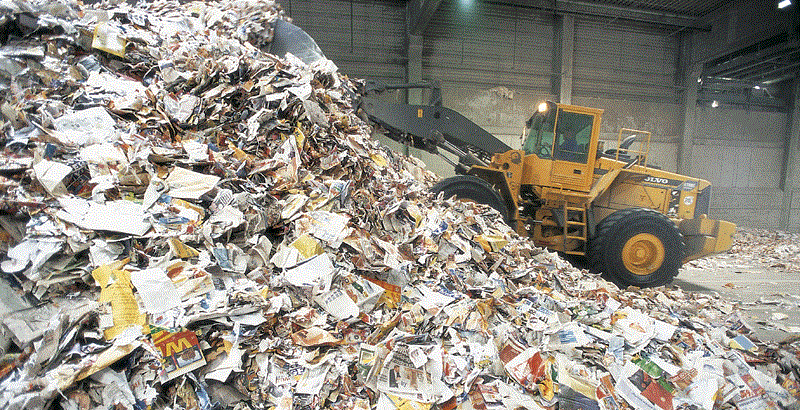
Most of us, from a very young age, are taught that one of the most important things we can do for the environment is to recycle as much waste as possible. In many cases, it is even socially acceptable to note and correct those who we see failing to do this.
Most cities have at-the-curb recycling programs that run alongside the original garbage collection routes, and some even have disincentive programs that are aimed at increasing recycling by charging each household for waste pick-up that exceeds a standard maximum (usually one garbage-bin per household). There is no shortage of elementary school projects aimed at recycling awareness and there are constantly charity recycling drives for various ailments that make people feel good about donating to a good cause and saving the environment. With so much recycling going on, how could we not feel good about our collective efforts to save the environment?
Well, what if I told you that recycling is NOT the best thing you can do for the environment? What if I told you it should really be low on your list of concerns?
Here’s why:
1. Reduce, Reuse, Recycle
When asked about the three “R”s, many respond with either bewilderment, blank stares, or, some of the more astute may respond with the scholastic 3 “R”s: Reading, wRiting, and aRithmetic. It would seem that what was once more common knowledge has begun to fade into the background: the 3 Rs of the waste hierarchy. The correct answer to “What are the 3 “R”s?” is: Reduce, Reuse, and Recycle.
The 3 “R”s were formulated to be understood as a list of commands from most to least important. Reducing is the action of most importance, where recycling is of the LEAST!
Reducing both your consumption of goods in general, as well as the amount of packaging containing those goods is, in terms of waste, the most important step towards a healthier planet: the fewer items you consume, the fewer things you will have to throw out in the end. This, combined with the obvious fact that consuming less means leaving more of the planet’s resources untouched, makes reducing the most crucial step in the three “R”s.
Reusing what items you do consume, along with any packaging you can use for alternate or similar purposes (e.g. using an old lidded jar as a take-along beverage container), is the next step in keeping waste from the landfill. This is another all-too-crucial step that tends to be missed in our society of disposable cans, cups, bags, cars, etc. It’s just too easy to purchase a new container, for instance, when you know that the last one was recyclable.
Finally, after you have reduced your consumption, and therefore have fewer items that can possibly end up in the waste bin, and reused what of the items you did indeed consume and could reuse, whatever is leftover should then be recycled.
In essence, the goal should not be to have a full recycling bin because you recycled so many things, but to have a nearly empty recycling bin because you consumed less, reused what you could, and recycled what little you had left over.
2. Downcycling is a more accurate term for what happens to your cans/bottles than recycling
Recycling, in many cases is more rightly called “downcycling”. That is, where there a few items that are able to be recycled with a fair amount of efficiency, a good deal of products labeled “recyclable” are only suitable to be recycled into an inferior product. Soda cans, for instance, are made from two different types of aluminum alloy which, when melted down along with the coatings and paints, combine to create an inferior product. In other words, a soda can cannot simply be melted down and made into another soda can as the meaning of “recycling” might suggest. Instead, a soda can is melted down and used to create an inferior product which, if it can even be further recycled, may be melted down and used to create an even more inferior product, and so on in this way until the recyclate is unusable and makes its way into the landfill after all.
This is does not mean that the recycling process is necessarily undesirable or condemnable, indeed it may be just as necessary as ever, but it does mean that we ought to bear in mind what recycling, in many cases, is: not a closed loop that keeps materials forever out of the landfill but more of a downward spiral that keeps materials out of the landfill for longer and allows us to consume fewer new resources over the same period of time.
3. Recycling is sometimes only a phrase: some is thrown in landfills (or even burned for energy)
Many materials labeled “recyclable” never go through the recycling process and are, instead, taken to the landfills in the end because our capitalist economic system forces us to decide which materials are “worth” recycling and which aren’t based on the net profits accrued from the production and sale of the recycled product. That is, for it to be “worth it” for a recycler to invest the man-hours, machine power, chemicals, etc., necessary to produce a certain recyclate (i.e. recycle certain products), the recycler must have a buyer who is interested in the recyclate.
If there are no prospective buyers, recycling a certain set of products constitutes a loss, therefore that set of products will simply be thrown out. On top of all this, certain products, though there might be prospective buyers for them, simply aren’t “worth” recycling since the cost of recycling them vastly outstrips their purchasing price. A good example of this is the plastic bag: it costs approximately $4000 to recycle 1 ton of plastic bags, but only $32 to sell 1 ton of the recyclate. In fact, as a result of the difficulty of recycling many plastics, only 6.8% of the plastic used in the United States is even recycled. This, again, is exactly what the process of recycling seeks to avoid or at least what we think the process of recycling avoids.
4.Recycling, like any other industrial process, also contributes to the world’s net pollution.
Recycling gets picked up by separate trucks which means more air pollution (not to mention the cost, in pollutants, of producing and maintaining said trucks). This can obviously be helped by outfitted trash trucks to also be able to deal with recyclables.
Recycling, for any product that must be melted down, throws even more pollutants into the air. This is why reducing and reusing are vastly more important. Recycling can create toxic waster. The recycling process for paper, for example, produces 40 tons of waste for every 100 tons of paper it produces.
This, again, is not an argument against recycling per se, but a caution. The less we have to recycle (because we have diligently followed the first 2 Rs), the less pollution we will create.
5. Recycling (or buying organic) doesn’t make you eco-friendly
The last (and possibly most important) reasons that recycling should be the last thing we do, are actually psychological reasons.
The first thing to consider is that, in our consumerist society, it is too easy to fall into the trap (and indeed history may have shown this to be true) of ‘it’s okay to consume more because I can just recycle it’. Since recycling’s introduction into the mainstream consciousness of the United States, waste per capita has increased from 2.7 to 4.5 lbs per day. It may indeed be the case that things like greater affluence and an increased market saturation of disposable goods have contributed to this rise, but it is more than likely that the justification for consumption that is recycling is a culprit as well.
Another consideration is the vindication afforded to people who recycle. That is, there tends to be a general sense that as long as one recycles, one has done one’s part for the environment when, even in the world of waste management, we see that that is clearly not even close to the truth.
Finally, we must consider that individuals possess finite stores of decision-making-power. If there are more important things for us to be doing than recycling, perhaps it is important that we spend our mental faculties pursuing such avenues instead.
In the end, I would like to stress that I am not arguing for the abolishment of the practice of recycling only that we put it in its place: last.
Sources:
http://www.popularmechanics.com/science/environment/a3736/4290631/
http://www.english.umd.edu/interpolations/2601
http://www.freshthemovie.com/2011/02/09/green-by-design-whats-wrong-with-recycling/
http://www.forbes.com/sites/amywestervelt/2012/04/25/can-recycling-be-bad-for-the-environment/
http://discovermagazine.com/2009/jul-aug/06-when-recycling-is-bad-for-the-environment