
In what Syriza’s party secretary calls that start of a “new era,” Greece has become the first nation in modern European history to elect a non-capitalist (which is probably better read as “not industry owned”) party as a major player in representative government. After counting 99% of the votes, the Syriza came out with approximately 36% and half of all MP seats, which is far more successful than any other left-leaning populist has been in Europe since the Franco-fascists overtook Catalonia in 1939.
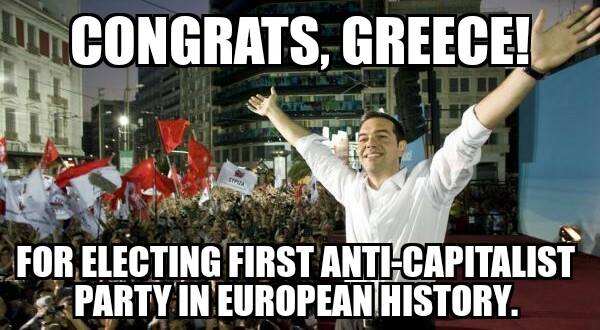
Only a week before the election, the Guardian was downplaying their chances as “slim” and describing them as “radicals.” Well, this “radical” party headed Alexis Tsipras has managed to take a big part of the vote, netting over almost half of all representatives (149 out of 300) with his anti-austerity, anti-banking, pro-public sector platform.
The Guardian describes him as someone who “promises all things to all men,” and claims that 30% of party members are actually militant radicals. But, was this just pre-election propaganda on an international level, or is Tsipras full of hot air? Looking at what is being written by mainstream “capitalist” sources, we see a pretty much consistent negative portrayal ranging from radical to anarchist to focus.de calling it an “EU-nightmare.”
Almost every article appears to be written in a fashion as to portray this as a grave mistake, an impossible situation, a hope certain to fail, but this certainty by so many sources is, in my eyes, potentially an indication that he may actually endanger parts of the status quo. Of course, it may also be an indication that this is not quite the political gift that leftists may see it as, and we need only think back to the “national socialists” to remember that rhetoric is not necessarily indicative of intentions.
Professor Tsakalatos, who also works as an adviser to Alex Tsipras in Syriza, says that the radicalism has been misunderstood:
“We are only more radical in the sense that we have been influenced by the anti-global movement and believe in concepts of participatory democracy… the angst Syriza has caused is down to us challenging a system that can’t actually represent the interests of ordinary people.”
At the very least, this is Europeans exclaiming loudly that they would rather take a chance with left-leaning anti-banking parties than the bread-and-butter industry parties pre-packaged for election. If this is the beginning of a new era, we can only hope that it is one of increased political participation, increased transparency, and increasingly responsible policy that favors investing in education and government services over a subsidizes banking sector.