
 President Barack Obama, Secretary of State John Kerry, and other prominent U.S. politicians seek to gain approval at home and abroad, to move forward with military action against the Syrian government. Many of those reluctant to support military action in Syria worry that the rebels the U.S. would be assisting are just as hostile and inhumane as the Syrian government of President Bashar al-Assad, and these critics now have more evidence to support their concerns and the majority of the Syrian population may still support Assad’s government.
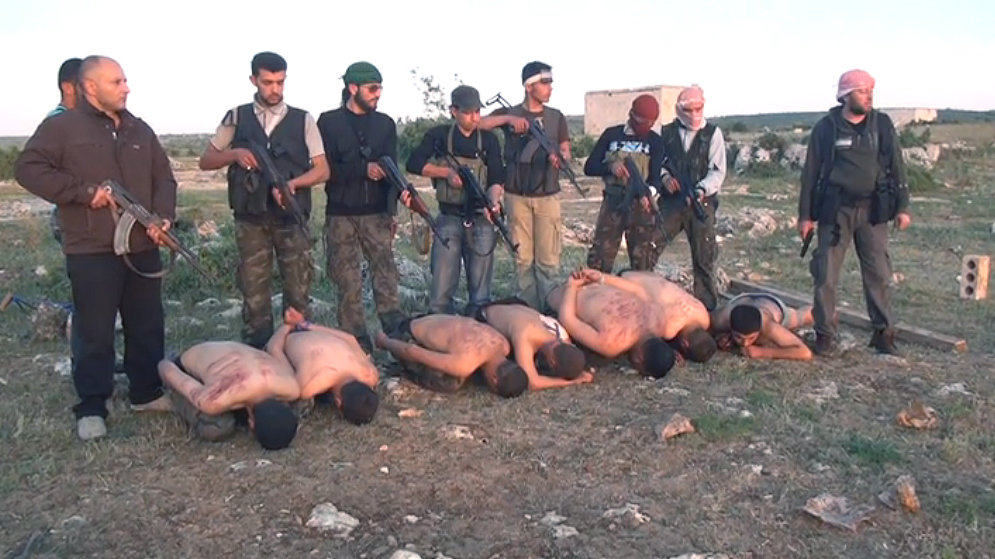
While many prominent voices in the United States government, such as John McCain, continue to insist that a high percentage of the rebels are moderates, it seems that may not exactly be the case. A recent video appears to depict rebel leader Abdul Samad Issa, known as “The Uncle” leading the execution of seven Syrian soldiers after proclaiming an extremist message. According to the New York Times the footage comes from a former rebel who was disgusted by this gruesome incident, so he bootlegged the footage out of Syria and delivered it to the American news publication.
This video, the audio of which was repeatedly played on U.S. news networks like CNN, adds to speculation over the U.S. rushing into another military conflict in the Middle East. Even though the video is not necessarily a good example of the way all Syrian rebels conduct themselves, it is definitely enough to cast doubt on supporting them with [more] U.S. tax dollars.
Meanwhile, President Obama is attending a summit in St. Petersburg, Russia, trying to convince other members of the Group of 20 (G20) developed and developing economies to support the U.S. in a limited military campaign against the Syrian government. Although the main purpose of the summit was to discuss economic revival, the split over whether to take action in Syria permeated the talks. Obama tried to make his case by reiterating that the alleged use of chemical weapons by the Syrian government against its own people was both immoral and illegal. He has the support of France but did not gain much more ground with his arguments.
Russia’s Vladimir Putin continues to insist that the Syrian rebels are actually behind the chemical attacks and stood strong in his position that Russia will not support military intervention until more evidence is presented by the U.N.
Obama clearly does not want to wait for a U.N. decision and the tension over this subject was evident in the behavior of the two leaders. China’s Vice Finance Minister Zhu Guangyao was also skeptical. He expressed concern that military intervention in Syria would impact the price of oil, thus impacting the economy negatively and hindering recovery.
If Obama follows through the U.S. could be drawn into yet another long and complicated war in the Middle East. Perhaps this is why he put the decision of whether or not to intervene militarily in Syria, into the hands of the Congress. One thing that is obvious: the situation in Syria is more complicated than the U.S. government is letting on.