
Most of us understand that the planet is warming, and that even though antarctic ice is slightly increasing: the overall amount of sea ice is pretty constantly decreasing. Both the direct release of heat through combustion processes, as well as the amount of heat being trapped by increasing levels of greenhouse gases like CO2 and CH4.
But words like “increasing” don’t seem to do justice, or provide any mental imagery, to what is going on. To rectify this disconnect between the science and public understanding, a new project (4hiroshimas) has been launched to help the average person understand global warming.
The science is based a number of scientific studies, and the project takes the latest figure of 250,000,000,000,000 Joules (250 trillion) per second and tries to make this number something a non-physicist can understand. 4 Hiroshima bombs per second is, to give you another reference, the same as about 500,000 bolts of lightning per second.
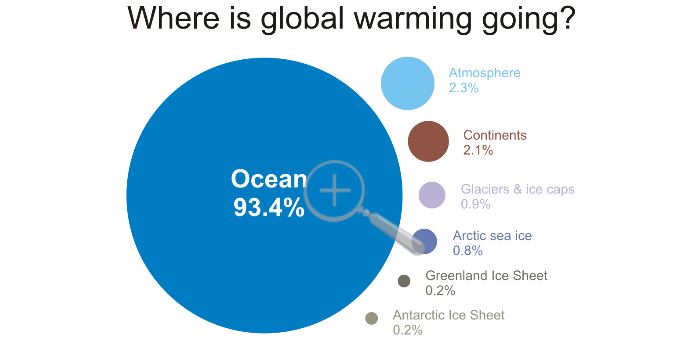
The reason that we don’t directly notice this dramatic increase in warming is that the vast majority of this energy is being stored in the oceans. The irony of this situation is that the hotter the oceans become: the less CO2 they can hold (also remember that the majority of global CO2 emissions get stored in the oceans, as well). Increasing production levels, as well as ever-further increasing CO2 emissions, threaten to push the oceans into releasing even more of their dissolved carbon and thus creating a positive feedback loop where increasing temperatures lead to oceans into releasing more CO2, which makes the oceans even warmer. We are already seeing a similar positive feedback loop with methane clathrates in permafrost and on the ocean floor.
The fact remains that the biggest slice of our ecological footprint comes in the form of carbon emissions. Although issues like deforestation remain important, no single area has increased quite as fast or as drastically as carbon emissions.
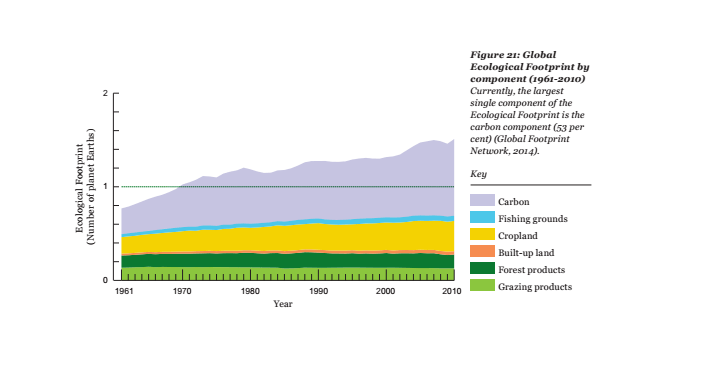
From the 2014 Living World Report by the London Zoological Society and the WWF. You can read my analysis here: http://www.exposingtruth.com/52-drop-animal-populations-40-years/
Taken together, we are collectively over-extending our resource use far beyond what the planet has to offer. We have been in a “biocapacity deficit” for more than the last 30 years, and we have lost 52% of all wild animals being measured since 1970. We are heating the planet at an increasing rate while also increasingly destroying natural ecosystems for financial gain: we have pushed the extinction rate to about 1000x its natural background level.

We are in, pun intended, quite a bit of hot water. The fact remains that these changes do not only affect humans, but indeed the entire planet and biosphere. The irony, though, is that human concern for this issue should be greater considering that our survival on this planet is highly dependent on a productive and functional biosphere. So, the question is not whether we are willing to “save the world,” but instead of whether we are willing to save ourselves and the hundred of thousands of species we appear to be trying to take with us.