
Sometime around late July of 2015, while searching news feeds and looking through articles, I began noticing that there was a subtle difference in tones, stories, memes, and language being used than I had been used to and/or exposed to over the years. I saw memes covering events and people being quoted saying things I was sure had never been. It’s difficult to explain exactly what stuck out, but it was as if someone had introduced memes that were 10 years old that everyone but me seemed to know the context of.
There were common phrases (colloquialisms) that people used that suddenly seemed to have a slightly different meaning or interpretation than what I would have previously ascribed to them. People spoke to me about things as if they had had the conversation a million times before around dinner tables and at bars for certain topics, and they spoke like they were describing the most obvious piece of small talk drivel ever spoken… but yet I’d never heard it that way before.
A blog article reminded me of this weird phenomenon called the Mandela Effect, which is attributed to Nelson Mandela’s purported prison death 20 years ago.
The Mandela effect is so named because a great number of people (in a 2012 survey) believe that he died in prison 20 years ago, and many have distinct memories of reading articles etc. about his death only to find out that he actually died back in 2013 and not before that while in prison. The mainstream interpretation is that people simply misremember or oddly collectively invent and pass along incorrect information to one another. There are however many other possible explanations for why large populations would seemingly recall what should be a stable fact differently than what public records provide.
In order to investigate this phenomenon, I briefly researched the topic of the Mandela Effect to find as many different largely applicable topics that appear differently to many people and wrote a survey asking about those topics. About 446 people took the quiz, which is where the following data comes from.
I also included 2 control questions within the survey to have something to compare against. In the case of the controls there are no Mandela Effects widely reported and as such they should provide good reference points to see how accurately people can recall non-controversial information. In each case, the control question was picked to reflect something from 10+ years ago to test for the chance of memory loss in the answers and create an expectation range for it.
The first control was “What is the name of the famous TV show?” The answer choices were Buffy the Vampire Slayer (correct), Buffy a Vampire Slayer, and Buffy Vampire Slayer. 96% of people responding to this question answered correctly. Of the 20 (4%) people that missed the question, 5 of them admit to simply guessing, which arguably has less to do with not remembering and more likely never having known the answer in the first place. This implies people are able to remember the name of a show that is over 10 years old with 97% accuracy. 4% guessed at the answer. 3% own the show. 28% used to watch it. 46% remember talking about it in general. 4% remember distinctly talking about the name. 4% cited other as a reason.
The second control was “A number of years back the ATF and FBI raided a compound in Waco Texas run by David Koresh. What was the group’s name?” This is a question added later, so as of this time there were only 265 respondents. 76% of them answered correctly. Of the 24% that got it wrong. 48 out of the 59 of them claimed to have guessed and the answer is likely more indicative of not including “I don’t know the answer” as an option than misremembering. After removing those 48 answers, it would appear again that 95% answered correctly.
The questions
Of particular interest, as well as international fame, the third Mandela Effect Question was “What did Darth Vader say to Luke when sharing his family relation?” in which 72% chose “Luke, I am your father,” 10% correctly chose “No, I am your father,” and 18% chose “I am your father.” Confidence levels were relatively low at 82% combined for extremely and moderately correct. 20% claimed they guessed. 39% said they used to watch it. 10% said they own the show. 23% remember hearing the line. 4% list other. 5% distinctly remember talking about it.
The eighth Mandela Effect question was more based around fact, it was “What is the universal blood donor type? O- is the correct answer, but 62% chose O+ and 29% chose O-. 9% chose AB. Confidence was moderately high with extremely and moderately combined totaling 81%. 8% of people reported knowing the answer because they have medical training. 2% knew because they were medical professionals. 11% heard people/media. 18% had distinct conversations about it. 21% guessed. 40% cite common knowledge. Among the medical professionals and those with medical training 17 thought it was O+ and 15 thought it was O-. All but two of the professionals or those with training were extremely confident in their answers.
Another common internationally known pop culture reference was the fifth Mandela Effect question: “What did the Disney queen say to the Mirror (it ends with who is the fairest of them all)?” The correct answer according to Disney is “Magic Mirror on the wall.” 93% chose Mirror Mirror while only 6% chose Magic Mirror on the wall. People were exceptional confident with 98% choosing extremely and moderately confident.
Referenced in many series and films is Kevin Cosner’s “if you build it, he will come,” which was the basis of the 7th question. The answer according to the publisher is “If you build it he will come,” but 90% chose “If you build it they will come.” Only 8% chose “if you build it he will come”, while the remaining 2% chose “if you build it we will come.” People were largely confident in their answers with 88% saying there were moderately or extremely confident and 55% said they had watched it.
The actual basis for the Mandela Effect, concerning the supposed death of Nelson Mandela, was not pronounced in this particular study in 2015. The question “Did Nelson Mendela Die in prison?” was a question I added after the initial survey went out and had 338 responses. History shows that he died after he was in prison. 13% said he died in prison. 73% shared he did not die in prison. 14% guessed. People were highly confident in their answers as 90% chose moderately/extremely confident. 31% knew their answer by remembering reading about it. 9% through general conversation. 23% heard through the media. 4% knew about this effect. 8% remember distinctly talking about it. 12% guessed the answer and 12% list other.
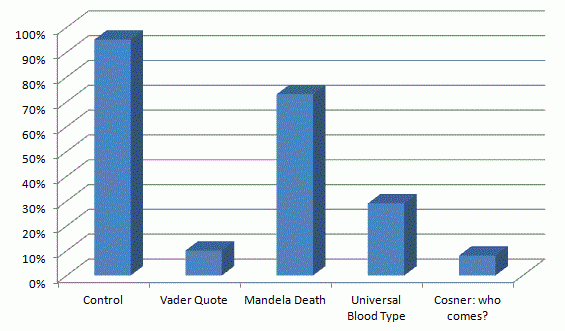
Percent correct answers from those completing the test (approximate 460 people)
When asked why people thought they had remembered some of the answers falsely, 14% thought it was about human memory problems, 10% based on a social version of the game of telephone, and 30% thought it was due to diverging timelines.
What does it all mean?
With some caveats in mind, I do think there are conclusions that can be drawn. 14% seem to think that the Mandela effect is simply about memory. The reason why the two controls are in this experiment is to test that conclusion. In both cases, the controls were being answered with 95% accuracy. Despite that one of the controls covered a TV show older than 10 years and one covered a current event older than 10 years, people seem to have really good memories about the names and events in question and with rare exceptions the only people that seemed to get them wrong were those who were forced to pick because no “I don’t know” option was present.
The controls make a strong case that it isn’t memory related or related to “multiple timelines ” and the fact that people still choose to believe that is probably more telling about the person and their willingness to change perspectives when presented with information showing them to have been in error. We can only imagine how much this effect is amplified when information has emotional value to the person remembering something in a specific way.