
There have been many texts published about the personalities of those who stay up late: correlating it with intelligence or risk-taking behavior and infidelity. An in-depth Psychology Today analysis displayed the average bed-times (as well as wake-up times) of different levels of intelligence (as measured by a standard IQ test).
Here are the 2 most relevant diagrams found in Psychology Today’s article:
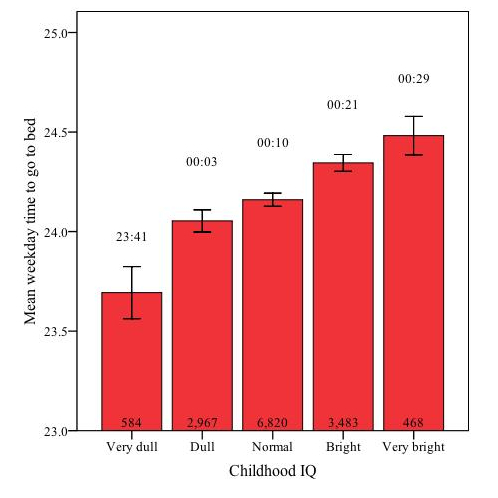
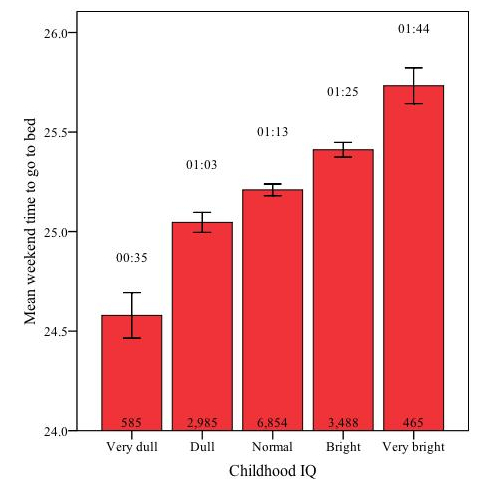
There would be many who react to these findings by questioning the validity of their model of intelligence, but it might be more apt to ask what qualities contribute to both intelligence and risk-taking. I would propose that instead of us evolving to stay up later being connected to “conscious choice”, but that instead intelligence is directly connected to a need-for-cognition.
Need-for-cognition is a personality aspect directly connected with the Big 5’s openness to new experience, and describes a person’s readiness to engage in novel cognitive effort, or experience new things. This personality trait leads a person to favor new experience or knowledge over that which is already established: the opposite of the corresponding need for stability.
It is unclear whether the ability to stay up late evolved on its own, or is simply a corresponding effect of an increasing desire to consume more information and experience. This drive would also inherently be bound to risk-taking; with the acceptance of greater personal risk being directly linked to the increased desire to experience the novel. This, of course, would be mediated by upbringing (which would have an effect on conscientiousness, another Big 5 personality trait), differentiating the “great minds” from the great professional daredevils.
This need-for-cognition makes no statements about discipline or work ethic, but merely the propensity or will to write and rewrite neural connections. Unsurprisingly, a need for stability is related to more extreme cognitive dissonance, meaning that an increased need-for-cognition makes a person more prepared to understand new perspectives and ideas (which is itself a mark of intelligence).
Of course, all of those “connected factors” also have alternative explanations, and their correlation with intelligence or a need-for-cognition are nothing definitive on their own in regard to causality. It would be easy to find anecdotal exceptions to any of the general trends represented in this text, but the trends are there.
So what does staying up late mean about you? Well, it may mean you are interested in learning and experiencing more, and more prepared to learn about things that seem to defy your world-view.