

With a voter turnout at 73.42% (11.6 million people), the incumbent president received 88.7% of the vote (10.2 million people).
Syrian President Bashar al-Assad has won a third term in office after reportedly securing 88.7% of votes in Tuesday’s presidential election. These are the official results given by Mohammad al Laham, Speaker of the Parliament of the Syrian Arab Republic.
“I declare the victory of Dr Bashar Hafez Assad as president of the Syrian Arab Republic with an absolute majority of the votes cast in the election,” parliament speaker Mohammad Laham said in a televised address from his office in the Syrian parliament.

Voting took place in government-controlled areas, but not in parts of the north and east held by radical (terrorists) groups. This obviously helped him achieve such a high vote of support.
Polls closed at midnight (21:00 GMT) after state media said voting had been extended for several hours because of a high turnout.
A total of 10.2 million people voted for Assad. The voter turnout stood at 73.42 percent. No violations have so far been reported, Syria’s Higher Judicial Committee for Elections said as quoted by SANA news agency (Official Syrian News Agency).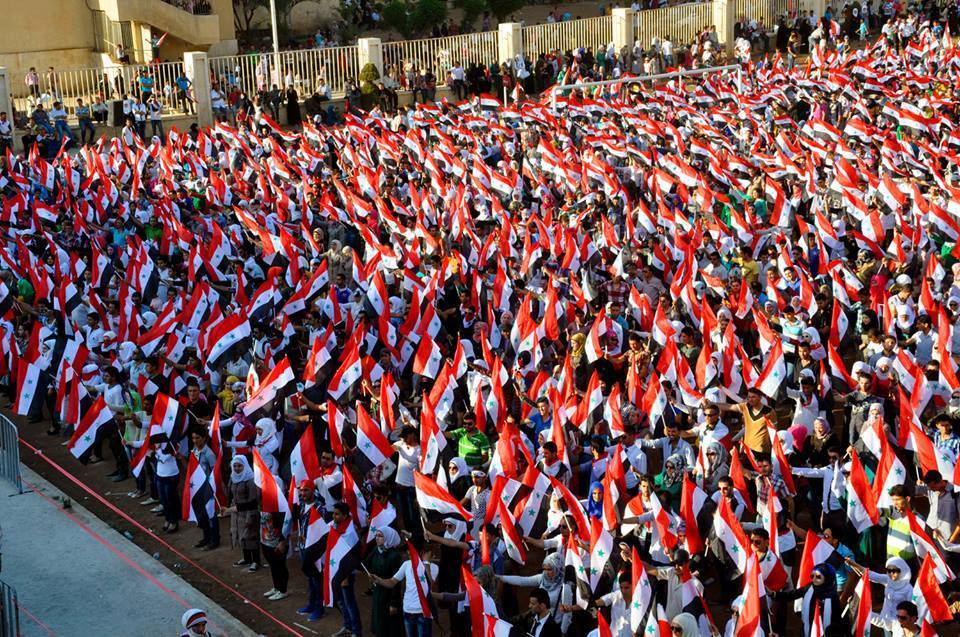
The two rivals of Assad remained far behind. Hasan Abdel Illahi al Nuri, 54, a businessman and ex-minister, obtained 4.3% of the vote, and Maher Abdul-Hafiz Hajjar, 46, a Communist from Aleppo, got 3.2% of the vote.

Syrian Prime Minister Wael al-Halqi said the election was a “historic day” for Syria and that a large turnout would “prove to the entire world that the Syrian people have decided and are determined to make the electoral process a success“.
The United Nations and western nations, on the other hand, argue that this hampers a political solution to the conflict and the odds of Assad stepping down. It is a little ironic that despite no allegations of corruption, western media has continued to push for a “transition” away from Assad. This should come as little surprise, since the U.S. and Saudi Arabia shared a vested geopolitical interest in the nation and have been aiding the rebels with military support and training.
Syrian Foreign Minister Walid Al-Mollaem stated that the elections are “the starting point of a political settlement“. He said Syria “returns to the safe coast so as to start a post-war reconstruction and reach a comprehensive accord“.

More than 250 foreign media, from all counties, had been licensed to cover the event. Many channels were making live broadcasting.
“This is not an election that can be analysed in the same way as a multi-party, multi-candidate election in one of the established European democracies or in the US”, says the BBC’s Jeremy Bowen in Damascus.
The Syrian authorities have appeared to comply with the democratic rules both in regard to the organization of the electoral campaign and the voting process itself. All journalists were allowed to move freely within the country and witness the validity of the vote.

Some refugees in Lebanon are crossing back over the border briefly to vote.
While opposition groups inside Syria, and most countries in the West, have still denounced the election as a sham, many Syrians are supporting President Assad and see him as the only option to return stability to the country (being, at the very least, not a foreign puppet).
The elections have faced sharp criticism from the US and its allies. “You can’t have an election where millions of your people don’t even have an ability to vote,” Mr Kerry said.
The EU said it could not be considered “a genuinely democratic vote”.
A delegation of the government’s main international supporters, including Russia, Iran and Venezuela, said the election was transparent and free, and that it would pave the way for “stability and national agreement“.

Elections Official Results:
– Bashar al-Assad (Baa’th Party/Alawite): 10,319,723 votes or 88.7% of the vote cast, representing 65% of the voting age population.
– Hassan al-Nouri (Liberal/Sunni): 500.279 votes or 4.3%.
– Maher el-Hajjar (Communist/Sunni): 372.301 votes or 3.2%.
– Blank and invalid votes: 3.8%.
This was the first time in recent history that a real vote, with alternatives, was held in Syria. Previously, Assad had run unopposed. In accordance with the 2012 Constitution, the president is elected through universal direct voting for a term of seven years and may be re-elected only once.