
I, like hundreds of thousands of others, watched a recent debate between a prominent creationist, Ken Ham, and Bill Nye, a well-known and respected TV personality and scientist/engineer. While watching the debate I couldn’t help but notice what most other people thought: neither one of them is getting their point through to the other. This article is not about this debate in particular, but largely about both sides represented within it.
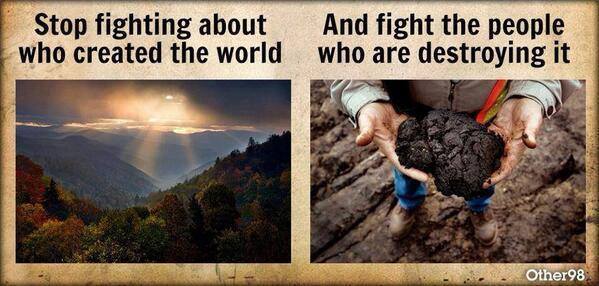
The goal of a scientist is to understand the observable world through observation and empirical science (empiricism means based on experience), looking to explain by disproving alternative theories until no number of experiments can destroy what is left. A creationist, be it Christianity, Islam, Zorostarism etc, holds the stance that the observable world was created by an unobservable intelligent entity. The two sides are not directly at odds with each other and never have been: they are two separate fields. Some of the first scientists, as we know them today, were actual monks (like Gregor Mendel). Darwin’s belief in natural selection did not impede him from also believing in a creator. Many, even today, maintain that creationism is in no way directly in opposition with evolution.
People’s beliefs are at odds with one another and that has always been the problem. Science doesn’t seek to acquire knowledge from what can not be observed, or tested, and so it can not answer questions about something outside of natural reality. Creationism is built on the idea that something intelligent caused natural reality to exist, there is no evidence that can ever prove or fully disprove that, so this position is philosophical.
Let me illustrate; if the Earth was created, the scientist would still only be able to explain the natural process of how the Earth formed. A scientist could never know, based off observation alone, that it was created and so a scientist would never conclude it was created because it can’t be observed or demonstrated. It would take a philosophical mind to conclude, based on his capability to reason, that a Creator must have created the Earth. One is observable knowledge, the other is a philosophical position: this doesn’t make either side right or wrong. And that’s good, because science keeps us from just believing things that have no basis in reality, like believing the Earth is the center of the Universe. But philosophy is necessary too, because it allows us to solve problems or understand our reality even in absence of evidence; its how we derive whats we consider to be ethical and how we developed language and math. In fact, the very first scientists were essentially all philosophers and scientific theory can thank philosophy its inception.
What the religious need to understand is that you can’t bring your beliefs and traditions to a forum, class or debate, when discussing facts of observable reality. You also need to understand that the religious who reject some scientific achievements do so because they feel it will somehow undermine their faith and convictions. This is a false belief because each field or paradigm has a different purpose. You can keep your faith in Creationism, and still fully embrace science.
But, this does require you to rethink many traditions and beliefs you thought were true… and that is not only ok: it’s the best way for humans collectively to progress with scientific discovery. The reason why many people leave faith once they hit college or become educated is because of the many beliefs that have been proven false that are still upheld by the religious. If the religious community is teaching people things that are proven to be false about the world we live in, then its natural for people to reject the source even with contempt.
If you are not embracing science, you are not embracing human progress in the advancement of medicine and technology and the understanding of the world around you. Religion and even Creationism has no place in scientific academia, you should think about religion in a science class as much as you would in a history class. Feel free to keep Creationism, and the tenets of your faith, but embrace the fact that some traditions and beliefs you may have could be wrong.
What the scientific community needs to understand is that Creationist comes in all types of forms. Some completely accept the progress in scientific, along with its discoveries, and some don’t. All these people come from different beliefs, backgrounds and religions. A person can be a creationist and not hold onto any belief or tradition that goes against science.
You also need to be sensitive to the fact that many Creationist who are religious feel as if there is an attack on them and their beliefs and convictions, and rightfully so. Many leading people in the scientific community have censored or mitigated valid criticism of some scientific discoveries and even to some degree show serious contempt of their religion. No productive conversation or outcome can come from that, regardless of “who started it first”. A person can accept scientific academia but not accept all the causal theories that come along with it.
The scientific community could generally care less about Creationism as long as the religious stop trying to interject clearly falsifiable beliefs into the classroom and politics. Creationists even generally love science until they feel their beliefs are under attack and valid criticism of science is undermined. The truth of the matter is neither are against each other: empiricism and philosophy are not enemies, but instead represent the two hands of progress.
Contrary to belief, the two sides can coexist easily: people only need to be more respectful, humble and honest. The religious should not be against science at all, as science is not against you even if some of the people are. Creationism is not, and should not, be a part of scientific academia since only the created can be observed, the creator and creation process can not be. The scientific community needs to understand that creationism itself is a reasonable philosophical stance even if some of the beliefs that may follow are not, and creationist individuals should not be met with contempt.
If we all can at least understanding this, then there would never need to be a debate between a Creationist and a Scientist, instead they’ll be solving problems together and making scientific discoveries based on their understanding of reality. One person may not believe in a creator and the other person may, but if both are willing to put belief aside and focus on solving problems: their beliefs become irrelevant.