
Brazil’s Indian Affairs Department, FUNAI, announced last week that an uncontracted tribe emerged from the rainforest near the Brazil-Peruvian border and made peaceful contact on June 29th with Brazilian government scientists.
Villagers from a settled indigenous community, know as the Ashaninka, radioed Brazilian authorities at least twice about a group of roughly 35 tribal strangers who were raiding their crops and trying to make off with machetes and other tools. In response, FUNAI dispatched a team of specialists, including medical personnel and Brazilian anthropologist José Carlos Meirelles, an adviser on indigenous matters to the government of Acre, a Brazilian state.
Officials suspect that the tribe fled illegal logging and drug trafficking in their traditional homelands in Peru.
The video below was created in 2011 to highlight issues faced by isolated tribes and those attempting to protect them.
Nixiwaka Yawanawá, an Indian from Brazil’s Acre state who joined Survival International to speak out for indigenous rights said, “I am from the same area as they are. It is very worrying that my relatives are at risk of disappearing. It shows the injustice that we face today. They are even more vulnerable because they can’t communicate with the authorities. Both governments must act now to protect and to stop a disaster against my people.”
 Anthropologist Kim Hill of Arizona State University, Tempe, who has conducted extensive fieldwork among Amazon rainforest tribes says FUNAI’s swift response is commendable. “There was a serious threat of violence between two native populations, and the intervention should eliminate that,” he says.
The meeting was Brazil’s first contact with an isolated Amazonian tribe in 20 years. Anthropologists remain deeply concerned about the tribe’s future as it encounters novel diseases and resource-hungry outsiders. Many previous contacts have ended in tragedy, as diseases such as influenza and whooping cough devastated tribes.
The Amazon rainforest has the largest concentration of isolated tribes in the world, with at least 70 in the Brazilian Amazon alone according to FUNAI. Many, if not most, have had at least fleeting contact with the outside world, particularly during Brazil’s rubber boom in the late 19th and early 20th centuries. Rubber tappers would round up and enslave indigenous tribespeople, after that, many populations fled to remote Amazon headwaters and cut off all contact with outsiders.
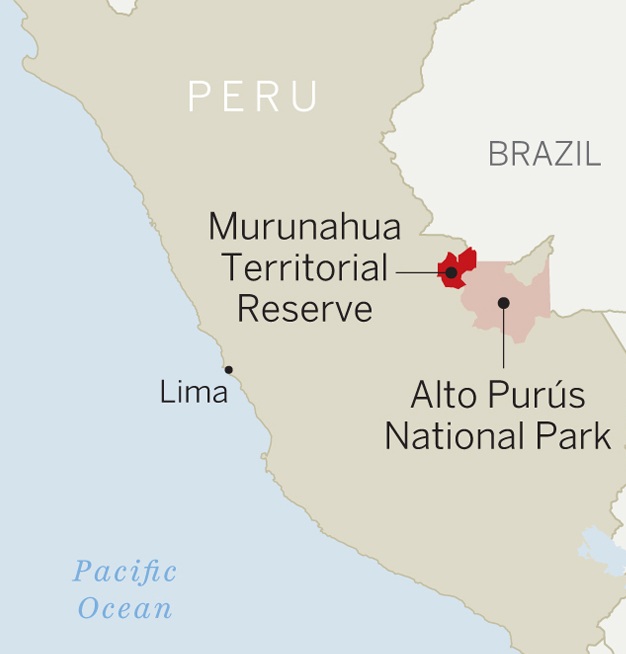 Officials think the tribe most likely migrated from a large area in Peru that includes Murunahua Territorial Reserve and Alto Purús National Park, 300 kilometers away (see map). The land is protected on paper, however illegal loggers there have built roads and set up base camps to cut down valuable mahogany. The logging is selective, but the heavy machinery may frighten off wild game, an important source of food for isolated people.
The cocaine trade is also intruding on the area according to a 2011 online report in GeoJournal by geographer David Salisbury, of the University of Richmond, and Chris Fagan, executive director of the Upper Amazon Conservancy in Jackson, Wyoming. Processors set up camps to make cocaine paste, and heavily armed traffickers now use the tribes’ traditional migration trails to reach river tributaries in order to transport their product into Brazil. “On the Purús River, the number of conflicts between uncontacted tribes and both coca workers and loggers has increased in recent years resulting in deaths on both sides,” they wrote.
The newly contacted tribe may have been fleeing such conflicts but Hill says that they may also have scouted out desirable resources such as game in the Upper Envira River area, or “they might have discovered that they can raid weaker neighbors and get goodies.”
The top priority now, says Robert Walker of the University of Missouri, Columbia, is to prevent disease transmission by quarantining the area, giving access only to individuals screened by medical personnel, and providing food and medical care to the elderly and young, who are at the highest risk of infection. “Vaccinations are a possibility at some point,” Walker says, but immunizations may frighten tribespeople, causing them to flee and carry pathogens to currently uncontacted people.
Stephen Cory, director of Survival International, expressed concern about the development. “Both Peru and Brazil gave assurances to stop the illegal logging and drug trafficking which are pushing uncontacted Indians into new areas. They’ve failed. The traffickers even took over a government installation meant to monitor their behaviour,” he said in a statement. “The uncontacted Indians now face the same genocidal risk from disease and violence which has characterized the invasion and occupation of the Americas over the last five centuries.”
Between 1983 and 1985, as much as 60% of a newly contacted Nahua population in the Peruvian Amazon died from illnesses such as influenza and whooping cough that they contracted from loggers, noted Beatriz Huertas Castillo, a private Peruvian scholar, in a 2004 report.
Corry said, “The only thing that will ensure the survival of modern-day uncontacted tribes is for their land to be protected. They have the right to decide whether to make contact with outside society, rather than be destroyed at the hands of an invading society. It’s vital that Brazil and Peru work together to protect the land of uncontacted tribes. History shows that when these rights aren’t upheld, disease, death and destruction follow.”
The fate of the newly contacted people may depend on whether FUNAI is willing to provide long-term medical monitoring and assistance, as well as some land that they can call their own. “So often in the past, people have been abandoned, and that first year of contact is extremely important, because that’s when you see these astronomically high figures of people dying.” says Fiona Watson, research director of Survival International.
FUNAI has a policy of not contacting isolated tribes, but has a contingency plan for when such groups seek to establish contact with the modern world. The department has been tracking four distinct isolated tribes in the region for more than 20 years.
Click here to write to the Peruvian and Brazilian governments urging them to immediately implement measures to ensure the Tribes’ lands and lives are protected.